
Close

AQUA-impact range

Wet blasting: degrease and clean in one treatment

In wet blasting, also called vapour blasting, a mixture of water and abrasive is driven onto your part by compressed air. Degreasing, cleaning and finishing happen in a single treatment, without dust and without harmful products. The Neptuna is the cabinet that does the work.

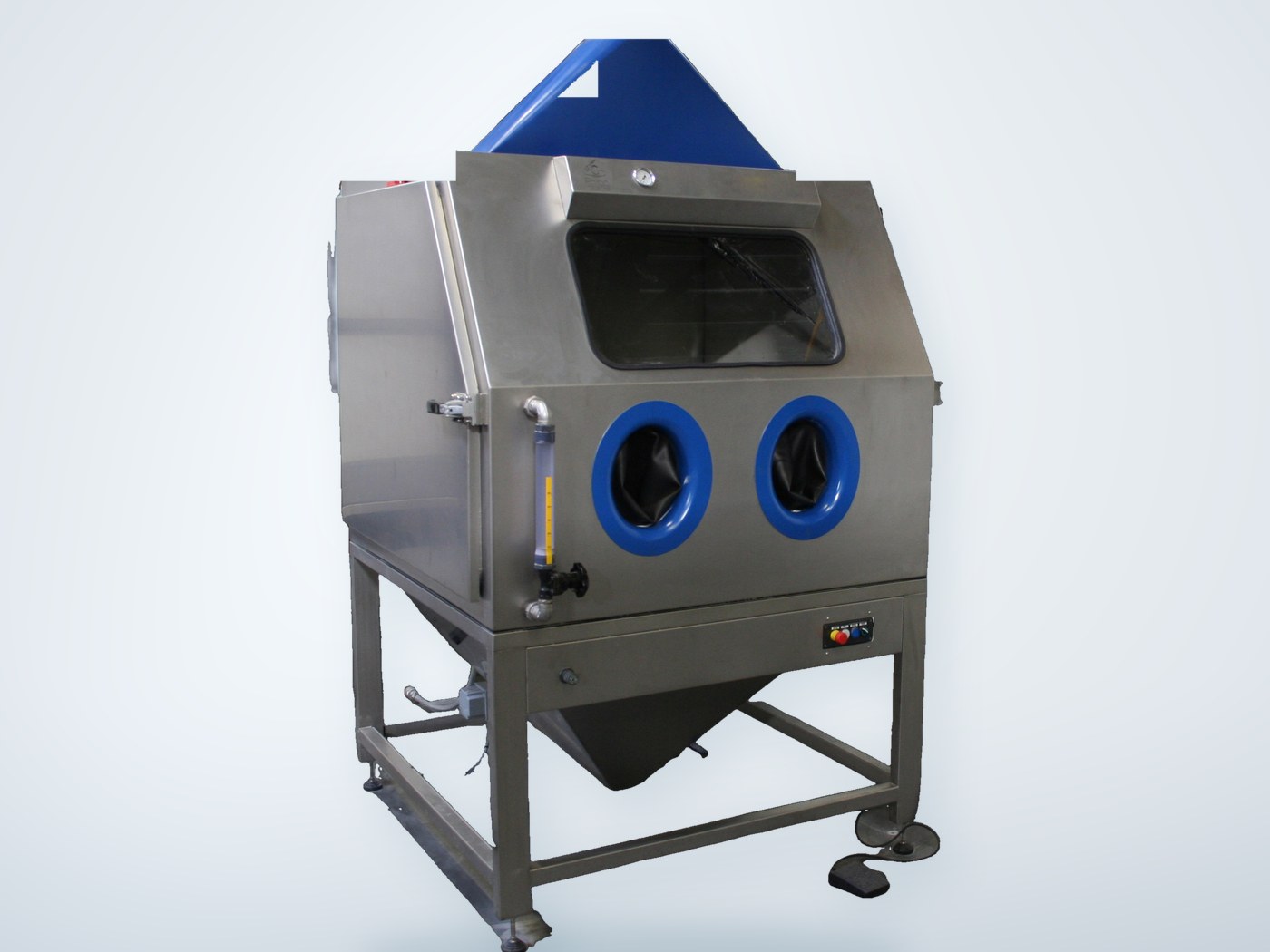
Neptuna wet blasting cabinet in stainless steel, with two sleeves and a viewing window
  • Surface technology specialist since 1988
  • Internal dimensions of about 1246 x 1246 x 1060 mm above the work grid
  • Sound emission of 70 dB(A) at the operator position
  • You arrange maintenance, repairs and spare parts directly with Phibo

Wet or dry

Wet blasting and dry blasting: what is the difference?

In wet blasting, a mixture of water and abrasive is driven onto the part by compressed air. In dry blasting, the abrasive hits the part dry, also driven by compressed air. That single difference, the water, decides what comes off the surface and how the part comes out.

Wet blasting and dry blasting side by side
FeatureWet blastingDry blasting
What reaches the partA mixture of water and abrasive, atomised by compressed airAbrasive in dry form, driven by compressed air
DustNo dustThe cabinet works with extraction and filtration
In one treatmentDegreasing, cleaning and finishing togetherCleaning and roughening the surface
What it does to the surfaceThe water buffer keeps the fine grains from embedding in the surfaceSets a rougher profile for the next coat
What you choose it forParts that have to be degreased and cleaned after overhaul or machiningRemoving rust, mill scale and paint before the next coat
How the part comes outWet; it is rinsed with fresh waterDry

If degreasing and cleaning have to happen together and no dust may be released, wet blasting is the process. If only the soiling has to go without treating the surface, you end up at the industrial parts washers, which work by spraying and immersion.

References

They rely on Phibo for surface treatment

The models

The machine: the Neptuna

Per model the key values, the features and the full specification table. Open what you want to check.

Neptuna cabinet with the external loading table on rails

The Neptuna with the external loading table, one of the extensions.

Neptuna

Wet blasting cabinet from the AQUA-impact range, listed as AQUA 1313

Internal dimensions1246 x 1246 x 1060 mm
Process pressure0 to 5 bar
Hopper volume200 l
Connection3 x 400 V, 5.5 kW
  • Degreasing, cleaning and finishing in one treatment, without dust
  • Built entirely in stainless steel, inner lining in white natural rubber
  • Viewing window of 750 x 430 mm, with sprayer and wiper
  • Vortex pump in solid polyurethane, directly driven by 5.5 kW
  • Extendable with turntables, heating, filtration and recovery
Price for this version
Technical data of the Neptuna
Model
NameNeptuna
Model in the AQUA-impact rangeAQUA 1313
ProcessWet blasting: water and abrasive, atomised by compressed air
VersionStandard equipment of the base cabinet; the extensions are listed in the table under Extensions
Cabinet
ConstructionFully stainless steel, on a frame with adjustable feet
Internal dimensionsApproximately 1246 x 1246 x 1060 mm high, above the work grid
Work surfaceReinforced composite grids across the full surface
Inner liningWhite natural rubber
AccessTwo side-hinged doors, each with a safety contact and a rubber curtain that forms a water gutter
Viewing window750 x 430 mm in safety glass, with automatic spray system and wiper
LightingFrontal and lateral led lighting
Operator stationPair of sleeves in anti-abrasive rubber, replaceable from the outside
Hopper volume200 l
Process
Process pumpVortex pump in solid polyurethane, directly driven, protected against overload
Motor power5.5 kW
Distribution networkSolid wear-resistant polyurethane; all process lines run inside the cabinet
Process gunErgonomic, with a boron carbide nozzle of 10 mm diameter, and a holster for hands-free work
Process pressureAdjustable from 0 to 5 bar, with regulator and pressure gauge
RinsingRinsing gun with stainless steel internals, on fresh water
ExtractionExhaust hood of 200 mm diameter with synthetic filter on top of the cabinet; acts as a mist separator and creates an upward air flow
Connections
Process gun connectionAt least 3/4 inch; 1,150 l/min at 7 bar with a 10 mm nozzle
Second connectionBSP at least 3/4 inch, 2 to 6 bar
Electrical3 x 400 V + N + PE, 50 Hz, 16 A, cable 5G2.5
Power rating5.5 kW
ControlTwo separate cabinets, one electrical to the national wiring regulations and one pneumatic
Foot controlOne start and stop pedal for all process functions
Safety and standard
Process linesFully integrated inside the cabinet
DoorsEach fitted with a safety switch
Sound emission70 dB(A), measured at the operator position
StandardIn line with the applicable CE legislation
AbrasivesWide range, thanks to the circulation circuit and the filtration principle

How it works

The wet blasting cabinet, seen from the inside

The Neptuna is built entirely in stainless steel. The operator works through two sleeves, with the process gun in hand and the start and stop control under foot. Everything that carries the process mixture sits inside the cabinet.

Three operations in one pass

Degreasing, cleaning and finishing of varied substrates happen in the same treatment, without harmful products and without dust.

Stainless steel on adjustable feet

The cabinet stands on a sturdy frame with adjustable feet. The inner lining is white natural rubber, which also keeps the walls easy to clean.

Two doors that catch the water

Both side doors swing open and each has a safety switch. The wear-resistant rubber curtain folds on opening into a gutter that catches splashes and so limits drips on the floor.

Viewing window of 750 x 430 mm

You look through safety glass. A sprayer and a wiper keep the window clear at all times. Frontal and lateral led lighting does the rest.

Vortex pump in solid polyurethane

The pump and its distribution network are in solid polyurethane, directly driven by a 5.5 kW motor. It keeps running, even after a long standstill.

Wide range of abrasives

The circulation circuit and the filtration principle allow a wide range of abrasives. One cabinet therefore covers a large number of applications.

Neptuna cabinet seen from the pump side, with the two control cabinets
The pump side, with the electrical and the pneumatic control cabinet.
Inside the wet blasting cabinet, with white rubber lining, composite grids and turntable
Inside: white natural rubber, composite grids, turntable.
Gun and nozzle, mounted inside the wet blasting cabinet
The gun and its nozzle, inside the cabinet.

Extensions

How you match the cabinet to your parts

The base cabinet covers a wide range of applications thanks to the possible configurations and customisations. Wheels and shapes that are hard to reach call for a tilting table, greasy and oily contamination for a heated mixture. The list below is not exhaustive.

1

Turntables

A fixed turntable holds bulky parts inside the cabinet while you turn them, without taking them out to reposition. A tilting table presents the part at the angle you want.

2

External loading table on rails

The turntable sits on a trolley that rolls out over continuous rails. Heavy parts are loaded for example with an overhead crane, and the hopper-shaped table catches the abrasive that falls off.

3

Heating of the process mixture

A 6 kW heating element in the process hopper, with an adjustable thermostat. Recommended for greasy and oily contamination, together with the universal cleaner V95².

4

Filtration and water saving

A labyrinth filter lets the coarse dirt settle, paper and synthetic media catch the rest. The recycling kit reuses the filtered rinse water in a closed circuit. A drain valve and a decanting valve let you empty and decant the mixture.

5

Hydrocyclone and magnetic separator

The hydrocyclone separates and recovers the abrasive. The magnetic separator removes the ferrous particles from the operating mixture.

6

Measuring and dosing

The external concentration gauge reads how much abrasive is in the mixture, as a percentage. An automatic dosing unit adds additives, such as detergent or a corrosion inhibitor.

Tilting turntable inside the wet blasting cabinet, with the process gun in the operator's hand
The tilting turntable, angled inside the cabinet.
External concentration gauge graduated in percent beside the cabinet
The concentration gauge reads the ratio in the mixture.
Options and their data
Turntables
Fixed manual turntableDiameter 1000 mm, load capacity 500 kg
External loading tableTurntable on a trolley and rails, diameter 1000 mm, load capacity 500 kg
Tilting manual turntableDiameter 800 mm, load capacity 500 kg in the horizontal position
Process
Heating unit6 kW in the process hopper, with adjustable thermostat; recommended process temperature 40 to 60 degrees maximum
Prescribed cleanerUniversal cleaner V95², machine compatible and matched to the heating unit
Concentration gaugeMounted in line with the circulation circuit, with a directly readable scale in percent
Dosing unitAutomatic, for additives such as detergent or a corrosion inhibitor
Filtration and water
Filtration systemLabyrinth filter with sedimentation compartments, plus fine filtration over a paper filter and a synthetic filter
Rinse water recyclingClosed circuit with a pneumatic diaphragm pump, about 20 l/min at 7 bar
Overflow controlAutomatic overflow membrane for regulating the filtration
ValvesDrain valve and decanting valve
SeparationHydrocyclone for separating and recovering the abrasive; magnetic separator for ferrous particles
Handling
Raised insert basketStainless steel with a synthetic mat, for small parts
Drum for batch treatmentFor small parts in batch, such as nuts and bolts
Blow-off gunFor blowing off after treatment
Process automation
Oscillation systemPowered oscillation of the guns
ExtractionVersion with condensate separator

Applications

What the Neptuna handles in one pass

Parts that have to be degreased and cleaned after maintenance, overhaul or machining. Oil, grease, carbon deposits, resins, glues, paint and corrosion come off without attacking the base material.

  • 1

    Pumps and valves

    Paint, rust and chemical deposits come off in a single operation. Pipework and similar parts are treated the same way.

  • 2

    Electric gearboxes and motors

    Steel, copper, bronze and aluminium are treated under control, without attacking the structure. Even complex assemblies go through the cabinet without full dismantling.

  • 3

    Turbines

    Turbine blades, discs, motors and linings are commonly wet blasted.

  • 4

    Automotive parts

    Alternators, brake calipers, starters and motors, with the carbon deposits removed. Moulds, tooling and aircraft parts go through the cabinet as well.

  • Will my part fit

    Inside, the Neptuna measures about 1246 x 1246 mm, with 1060 mm of height above the grid. If your part does not fit, the range holds a blasting platform. Send us the dimensions, the weight and the contamination.

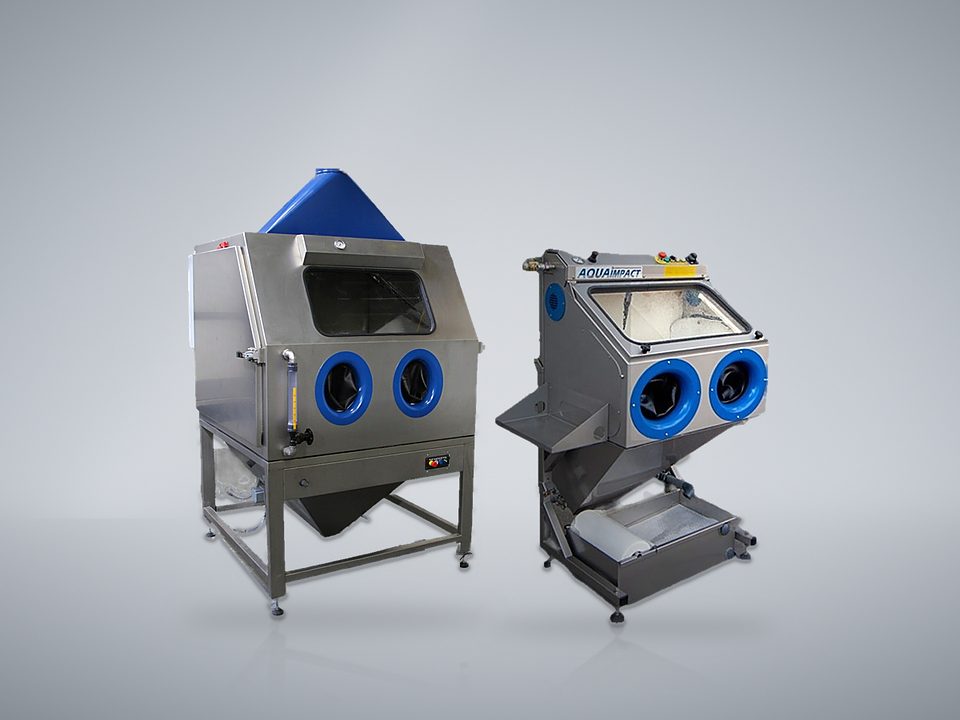
The AQUA-impact range

The other wet blasting installations

Besides the Neptuna, the range has two more sizes. Which one suits you depends on your largest part and on how you present it. We go through that with you.

The compact cabinet

The AQUA 0806 is the smallest of the range and adjustable in height. It has an extra large viewing window at an adapted angle and led lighting.

The blasting platform

The AQUA 3000 is not a cabinet but a platform with a large work surface on which the operator stands. For parts too large for any cabinet.

Consumables

Which abrasive and which cleaner go into a wet blasting cabinet

The process mixture is water plus abrasive. The circulation circuit and the filtration principle of the cabinet allow a wide range of abrasives. With greasy and oily contamination the heated cabinet works together with the universal cleaner V95².

From our own warehouse

We keep abrasives, cleaners, additives and protective equipment in stock, so you order them from the same partner as the installation.

  • Abrasives for wet processes
  • Universal cleaner V95²
  • Additives, including corrosion inhibitors
  • Paper filters and synthetic filters
  • Operator sleeves and nozzles
  • Personal protective equipment

Assistance and service

Maintenance, spare parts and training

You arrange maintenance, repairs and spare parts directly with Phibo. Our own technicians do the work.

Maintenance contract

We plan the inspection of your installation and follow it up. You agree the content with us.

Repair and spare parts

The spare parts come from our own warehouse. Our technicians carry out the repair.

Training

Your operators learn to run and set the installation, at commissioning.

We call you and go through your application

Send us the dimensions and weight of your parts, the contamination that has to come off and the number of parts per day. You receive a proposal with the cabinet and the equipment that fit. One partner, from the first conversation to the last spare part.

Request

Request your quote or a price indication

With these details we determine the cabinet together. We call you and go through your application, and you receive a proposal with the full specifications. The request form is right below.

  • Dimensions and weight of your parts
  • The contamination that has to go, by name
  • The number of parts per day
  • The free space and the access in your workshop

Subscribe to our newsletter