Blasting space to size
Structural steelwork, chassis and welded frames are too large for a blast cabinet. The operator then walks into the blasting space instead: HALL-impact as the heavy industrial blast room, STEP-impact as the walk-in cabin built to your size, HALL-impact Mobile as the blast container without foundations.
Three systems
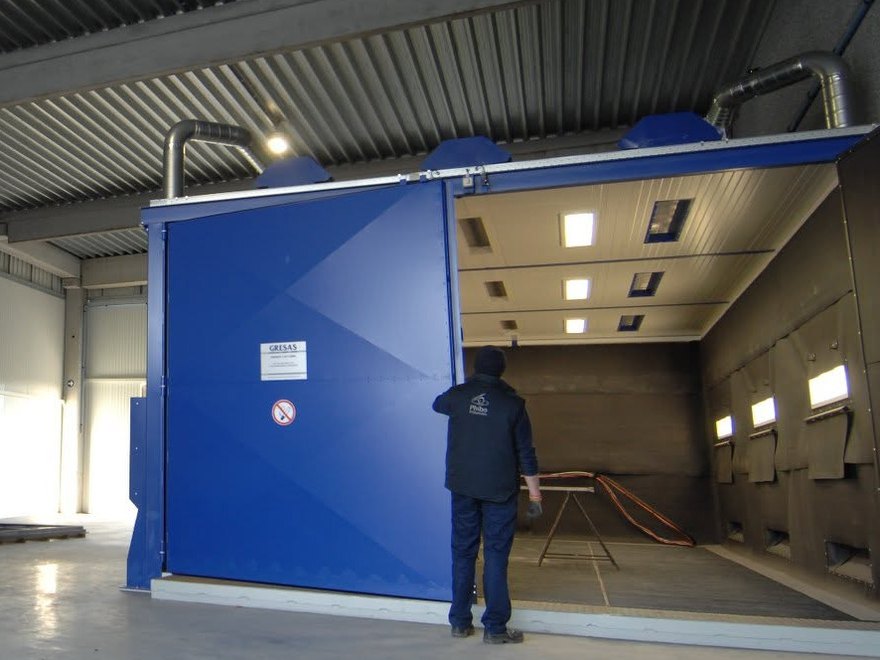
A blast room, also called a blasting hall, blasting chamber or sandblasting room, is an enclosed blasting space the operator walks into, for parts that are too large for a blast cabinet. All three give you a complete blasting space; the difference lies in how heavy the build is and in how it reaches you. There is no standard size: the industrial blast room and the walk-in cabin are built around your largest part, the blast container has a fixed size.

Developed, built and installed in house. Acoustic walls of 80 mm, a frame on portal frames and a scraper floor that carries the abrasive away continuously.

Phibo first makes the study and sets the dimensions, and then supplies every part separately: the cabin, the blast pot, the recovery, the dust extraction and the protective equipment.
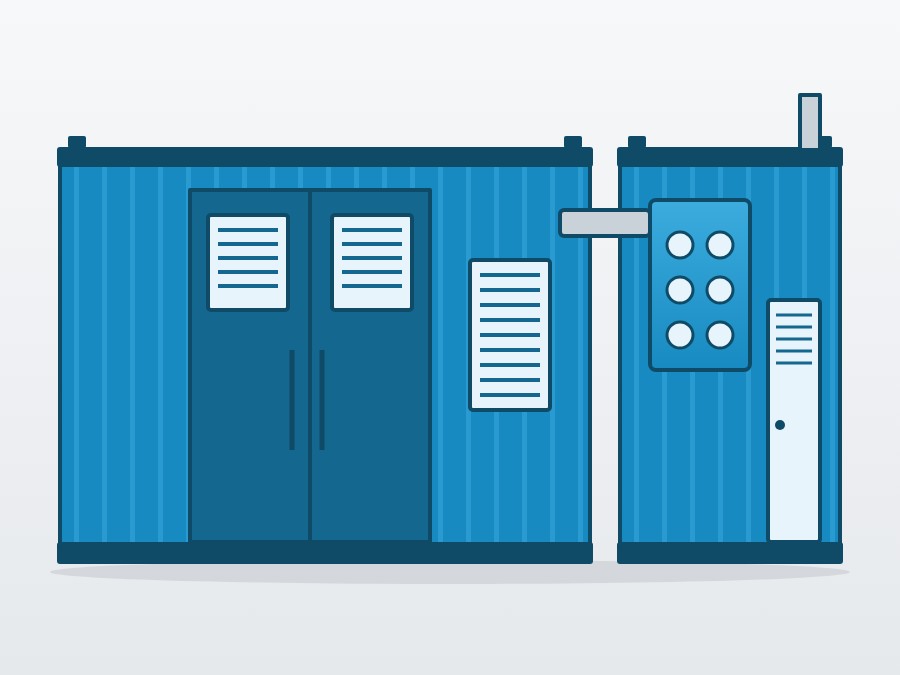
Fully assembled in the factory and delivered in two parts. No foundations, no drilling: after placing it you blast straight away.
Scroll the table to the left for STEP-impact and the blast container.
| What you get | The industrial blast roomHALL-impact | The walk-in cabin to sizeSTEP-impact | The blast containerHALL-impact Mobile |
|---|---|---|---|
| Choose this if | You want the complete blasting space turnkey, built and installed | You have the space in your workshop and choose which parts you take now | You want to start without construction work |
| The blasting space | Heavy-duty build, made to your size and installed | Made to measure, after a study of your application | Fully assembled in the factory |
| The walls | Acoustic sandwich panels of 80 mm, fire resistant, on portal frames every 3 m | Determined together with the cabin, during the study | Factory built, in sandwich panels |
| The interior lining | Rubber curtains of 3 mm, every vertical wall and door protected | Abrasion-resistant rubber curtains of 2 to 3 mm | PVC wall protection |
| The dimensions | Made to measure, set by your largest part and the number of operators | Made to measure, worked out by Phibo | Standard version |
| The recovery | Scraper floor with bucket elevator: the abrasive leaves while you keep blasting | Pneumatic if you blast intermittently, a scraper floor if you blast continuously | Suction hopper in the flat steel floor |
| Construction work | Limited foundations, above ground placing possible | According to the recovery you choose | No foundations, no drilling |
| Transport and placing | Phibo handles assembly and commissioning | Phibo handles assembly and commissioning | Two parts, by standard transport |
| Extending later | The recovery system grows without altering the equipment already installed | You add the parts you did not take yet | Service door, drive-on plate and scraper floor as options |
The industrial blast room always gets a fully automatic scraper floor. For the walk-in cabin you choose between pneumatic recovery and a scraper floor. In both cases the dust extraction is calculated on the section of your blasting space and the number of operators.
References
Our installations run at companies in metalworking, rail, aerospace, automotive, chemicals and the rubber and plastics industry.
 Metalworking
 Rail
Rail Aerospace
 Automotive
 Chemicals
 Rubber and plastics
Setting the size
The floor area follows from two things: your largest part and the number of operators. This is how we work it out.
The dimensions of the largest part to be blasted form the basis of the room.
Count on at least 1.20 m of free space around the part, plus extra height if you suspend parts.
Every operator blasting at the same time needs his own working space.
The cross-section of the room determines the size of the filter. An oversized room means a larger and more expensive filter.
Allow a waiting area in front of the blast room. If you want to blast continuously, access doors are fitted at both ends.
The industrial blast room
Development, construction and installation happen in house. The room is built to the size of your largest part and the number of operators blasting at the same time, and the recovery system can be extended later.
Acoustic sandwich panels of 80 mm, fire resistant. Noise emission stays below 80 dB at 1 m.
Portal frames every 3 m with cross bracing, connecting plates and reinforcing beams. A split roof or an internal monorail is possible.
The access doors have a labyrinth design, so the air flow keeps circulating. The useful opening equals the blast room section.
Fire and abrasion resistant rubber curtains of 3 mm, overlapping and hung horizontally. The emergency door has an anti-panic system and a window in safety glass.
Light boxes in the side walls and the ceiling, with three lamps per box. The glass is replaced from inside the room, and the electrical connections sit on the outside.
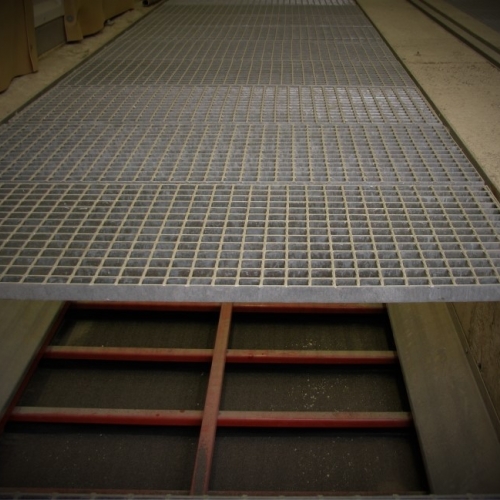
The scraper floor pushes the abrasive to a bucket elevator that handles up to 600 kg/min. The abrasive is removed while blasting continues.


All technical data for HALL-impact
| Dimensions | Made to measure, set by your largest part and the number of operators |
|---|---|
| Noise emission | Below 80 dB at 1 m |
| Walls | Acoustic sandwich panels of 80 mm, fire resistant |
| Frame | Portal frames every 3 m, with cross bracing, connecting plates and reinforcing beams |
| Roof | Optionally a split roof or an internal monorail |
| Interior lining | Rubber curtains of 3 mm, fire and abrasion resistant, mounted horizontally and overlapping; every vertical wall and door is protected |
| Lighting | Light boxes in the side walls and the ceiling, three lamps per box, glass replaceable from inside, connections on the outside |
| Access door | Labyrinth design; the useful opening equals the blast room section |
| Emergency door | Anti-panic safety system and a viewing window in safety glass |
| Other version | Also available as a metallising booth, in the same build with 80 mm sandwich panels |
| Standard widths | 1000, 1200, 1350, 1600, 1800 and 2000 mm |
|---|---|
| Width 1350 mm | Made to fit between railway tracks |
| Installed height | 150 mm; can also be placed above ground, with a height difference of 150 mm to the existing floor |
| Foundations | Limited; above ground placing needs no foundation work |
| Movement | 300 mm stroke back and forth, blades every 200 mm; every track has its own mechanical drive |
| Blades | In steel, with a backstop over the full length, so they stay true and do not block |
| Wheels | Robust and dust tight; no contact between abrasive and bearings |
| Abrasive recovery | Partial with 1 or 2 lengthwise tracks, complete from 3 tracks on; extendable later without altering the equipment already installed |
| Discharge | A transverse scraper track carries the abrasive to the foot of the bucket elevator |
| Gratings | In deep drawn sheet |
| Heavy duty gratings | 5 tonnes per forklift wheel at a contact surface of 200 x 200 mm; heavy parts may be set down on them directly |
| Maintenance | Low; contact surfaces in high grade steel with good wear resistance |
| Bucket elevator | Up to 600 kg/min, in 4 mm steel; absorbs a peak flow without jamming |
|---|---|
| Separator | Vibrating screen at the top for coarse contaminants, discharged to a waste collector |
| Fine cleaning | Dynamic air washing; the efficiency is set to the specific weight of the abrasive |
| Separator option | Magnetic drum, against iron contamination or for two abrasives in the same blast room |
| Storage silo | 500 l per blasting machine, for 1 to 4 machines, in a raised version on feet |
| Blast pot | 200 l as standard, to the PED directive, with remote control with silencer, blast and control hoses and a high power nozzle |
| Protective equipment | Full equipment for the operator, approved in line with the legislation |
| Air circulation | Horizontal or vertical, according to the room dimensions and the number of operators; the room is always under negative pressure while blasting |
|---|---|
| Cartridge filter | 6,000 to 100,000 m3/h |
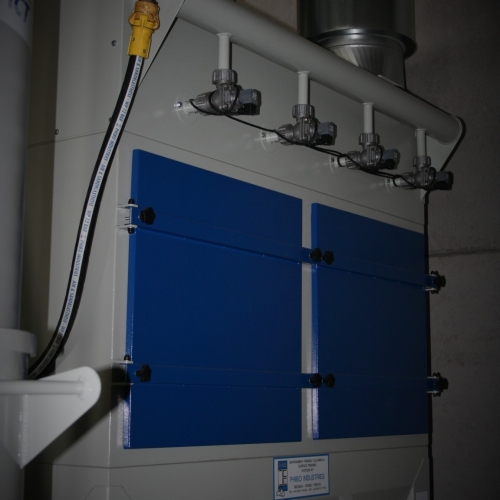
| Filter cleaning | Automatic and sequential with compressed air, with permanent monitoring of the fouling level |
| Cartridges | Antistatic, as standard |
| Fan | Centrifugal, fitted with a silencer as standard |
| Standards | The filters meet the applicable standards for dust emission and noise level |
| Option | Heating of the incoming air, set by the required room temperature and the available energy |
Rather speak to someone first? +32 55 21 98 99
The walk-in cabin
Every walk-in cabin is built to measure. Phibo first makes the study: which size you need, how much air has to move through the cabin and which filter fits that. After that everything comes part by part, so you choose what you take now and what comes later.
An enclosed blast cabin with an access door and an emergency door, abrasion-resistant rubber curtains of 2 to 3 mm and the lighting of the blasting space.
Designed for 12 bar and protected by a calibrated relief valve. With remote control and dead man's handle, and a metering valve that regulates the abrasive flow.
Blast helmet with panoramic or rectangular visor and a silencer in the breathing air supply, blast suit, gloves and safety shoes. Approved to CE marked as personal protective equipment.
Pneumatic for intermittent blasting, or a scraper system with bucket elevator and cascade cleaner for continuous work.
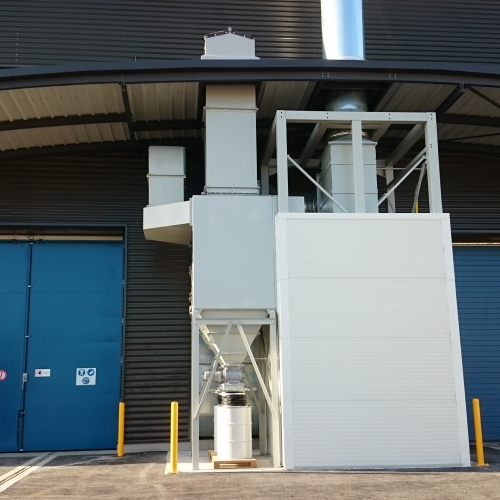
Dry cartridge filters with antistatic cartridges, cleaned automatically by compressed air pulses. The dust collects in a container under the filter.
Screw compressors in stationary or mobile versions, with air receiver and dryer, and a breathing air filter that purifies the air for the operator.
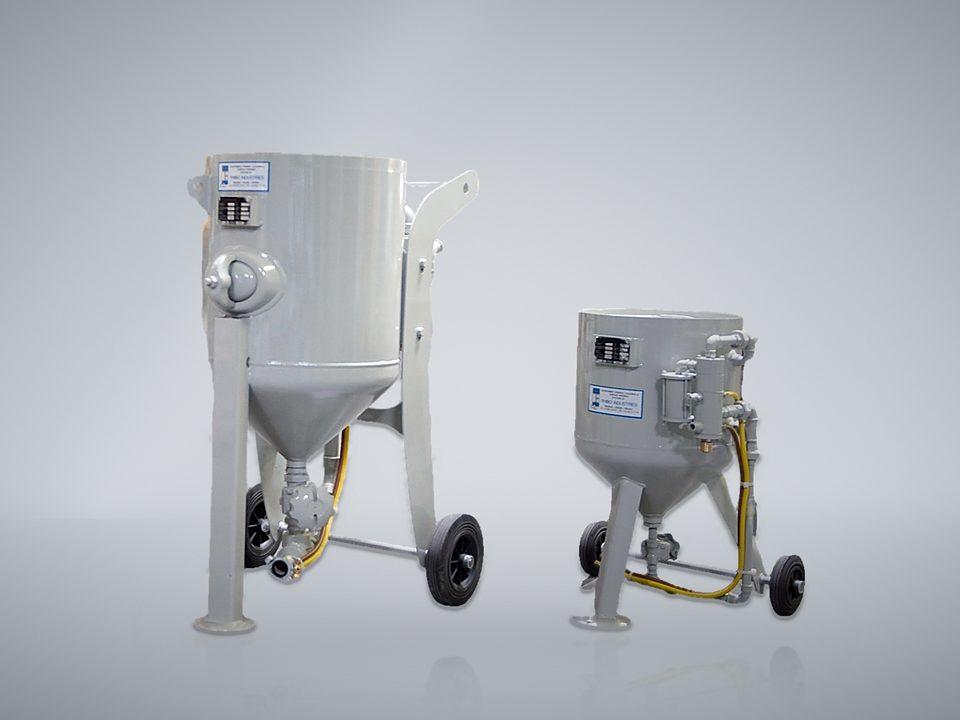
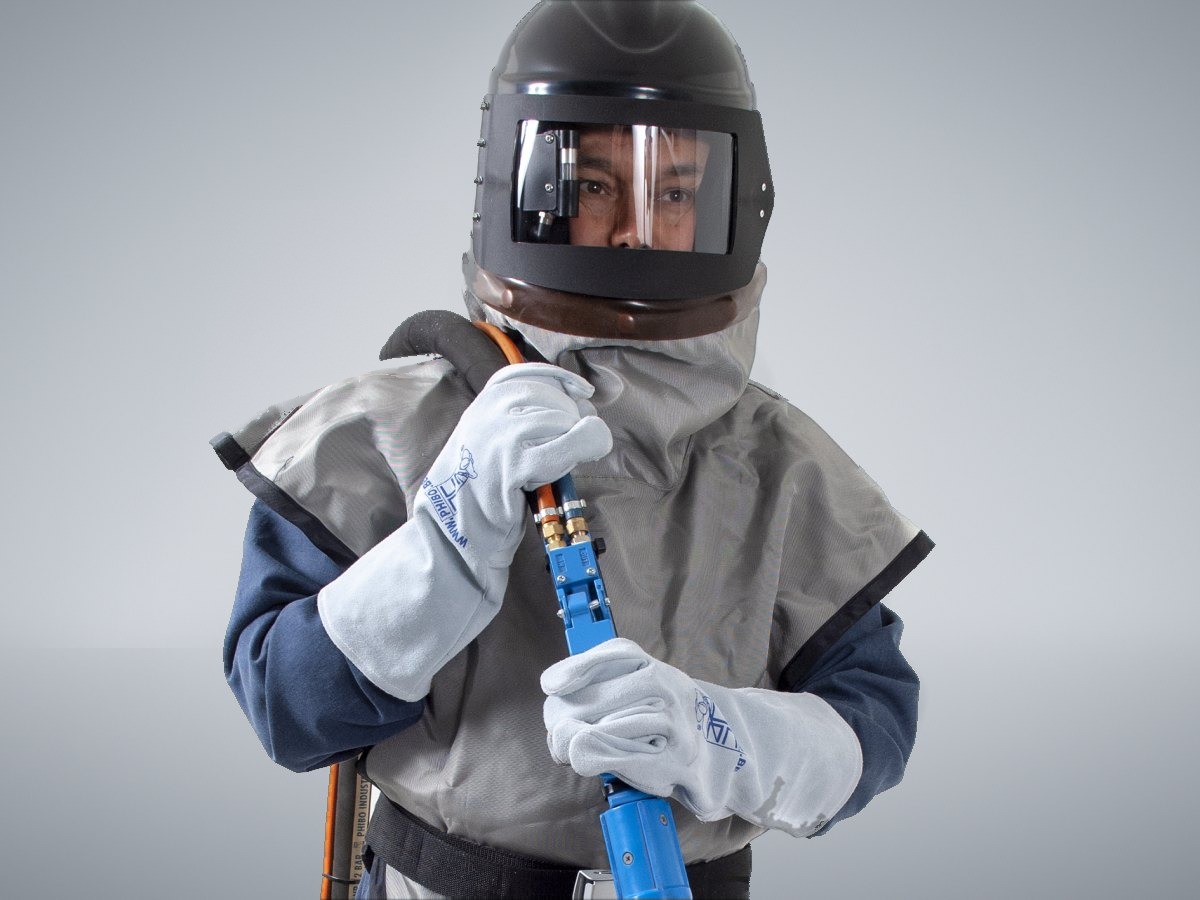
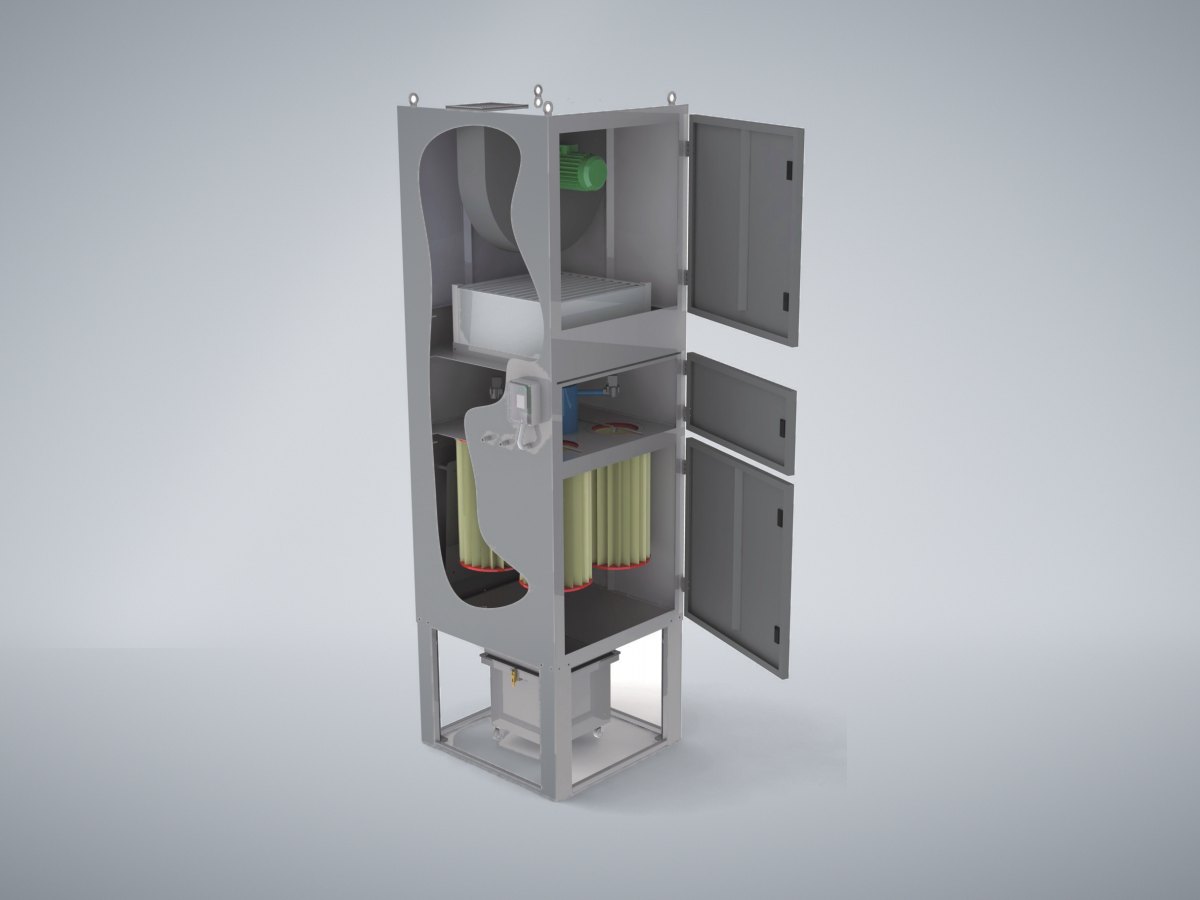
All technical data for STEP-impact
| Dimensions | Made to measure, set by your largest part and the number of operators |
|---|---|
| Space around the part | At least 1.20 m, plus extra height for suspended parts |
| Interior lining | Abrasion-resistant rubber curtains of 2 to 3 mm |
| Access | Access door and emergency door; doors at both ends for a continuous blasting process |
| Waiting area | Recommended in front of the blasting space |
| Design pressure | 12 bar maximum, protected by a calibrated relief valve |
|---|---|
| Control | Remote control with silencer and dead man's handle, for immediate start and stop |
| Pressure control | Combined filter and blast pressure regulator, standard in the basic equipment |
| Air lines | Generously sized, with minimal pressure loss |
| Coupling | Bayonet fitting with safety clips, antistatic blast hose against build up of static electricity |
| Metering | Diaphragm metering valve, pneumatically controlled or not, or a slide metering valve; the choice follows from the working conditions and the abrasive |
| Filling | Funnel shaped top with an automatic sealing cone |
| Outlet | Conical shape at the bottom, for a natural flow to the metering device |
| Moving it | Large wheels, a wide wheel base and a sturdy handle |
| Blast helmet | Two types, with a panoramic or a rectangular visor, both with a noise reducing silencer in the breathing air supply |
|---|---|
| Blast suit | Breathable, antistatic and flame retardant, CE marked as personal protective equipment |
| Gloves | Supple leather with a soft cotton lining, covering the hands past the wrist |
| Safety shoes | Antistatic and lightweight, in abrasion-resistant, water-repellent materials, with a low or high ankle |
| Breathing air filter | Removes oil mist, water vapour and dust particles down to 0.5 micron, and reduces smell and taste; up to 4 connection points |
| Pneumatic | Automatic extraction from a recovery hopper to separator and storage silo, sequentially at every stop; the abrasive returns to the blast pot through a screen |
|---|---|
| Option | Secondary circuit with a floor vacuum, for corners, recesses and cavities, which limits carry-over losses |
| Scraper system | Bucket elevator with cascade cleaner, for continuous blasting without interruption |
| Cascade cleaner | Air cleaning with an adjusting plate that sets the degree of separation; coarse contaminants stay in a screen |
| Standard widths | 1000, 1200, 1350, 1600, 1800 and 2000 mm; the length is practically unlimited |
| Gratings | 250 kg/m2 as standard |
| Foundations | Limited in depth, and can also be built above ground |
| Storage silo | Capacity to suit the blast pot and the running time you want |
| Ventilation speed | 0.30 m/s horizontally in the working zone, higher with heavy dust or toxic substances |
|---|---|
| Filter type | Dry extraction, more than 99 per cent for particles above 1 micron |
| Air flow | 800 to 100,000 m3/h, larger capacities on request |
| Dust emission | In practice below 0.1 mg/m3; the value for your application is stated in the quotation |
| Cartridges | Antistatic polyester, usage class M to EN 60335-2-69, with an emission below 0.1 per cent for particles between 0.2 and 2 microns |
| Cleaning | Sequential compressed air pulses, electronically controlled by an adjustable microprocessor; pulse time and pause time adjustable |
| Fans | Centrifugal with direct drive, without belts |
| Dust collection | Dust tight movable container under the filter; other solutions on request |
| Stationary compressor | 0.2 to 16 m3/min, 7.5, 10 or 13 bar maximum, electrically driven, with or without variable speed |
|---|---|
| Mobile compressor | 1.2 to 27 m3/min, 7, 10, 12 or 14 bar maximum, petrol or electric; optionally with a generator |
| Accessories | Vertical or horizontal air receivers, dryers and coolers, condensate treatment and pressure holding systems |
Rather speak to someone first? +32 55 21 98 99
The blast container
A blast container is a blast room in standard form: fully assembled in the factory, delivered in two parts and quickly placed. After placing it you blast straight away, without extra construction work.
The complete unit consists of two parts and travels by standard transport. After the quick placement, blasting can start right away.
Cyclone, blast pot and filter with automatic filter cleaning are built in and connected at the factory.
A flat steel floor with a suction hopper collects the abrasive, so that it is reused.
PVC wall protection, lighting and extraction for good visibility in the space. The walls are made of sandwich panels, to reduce the noise.
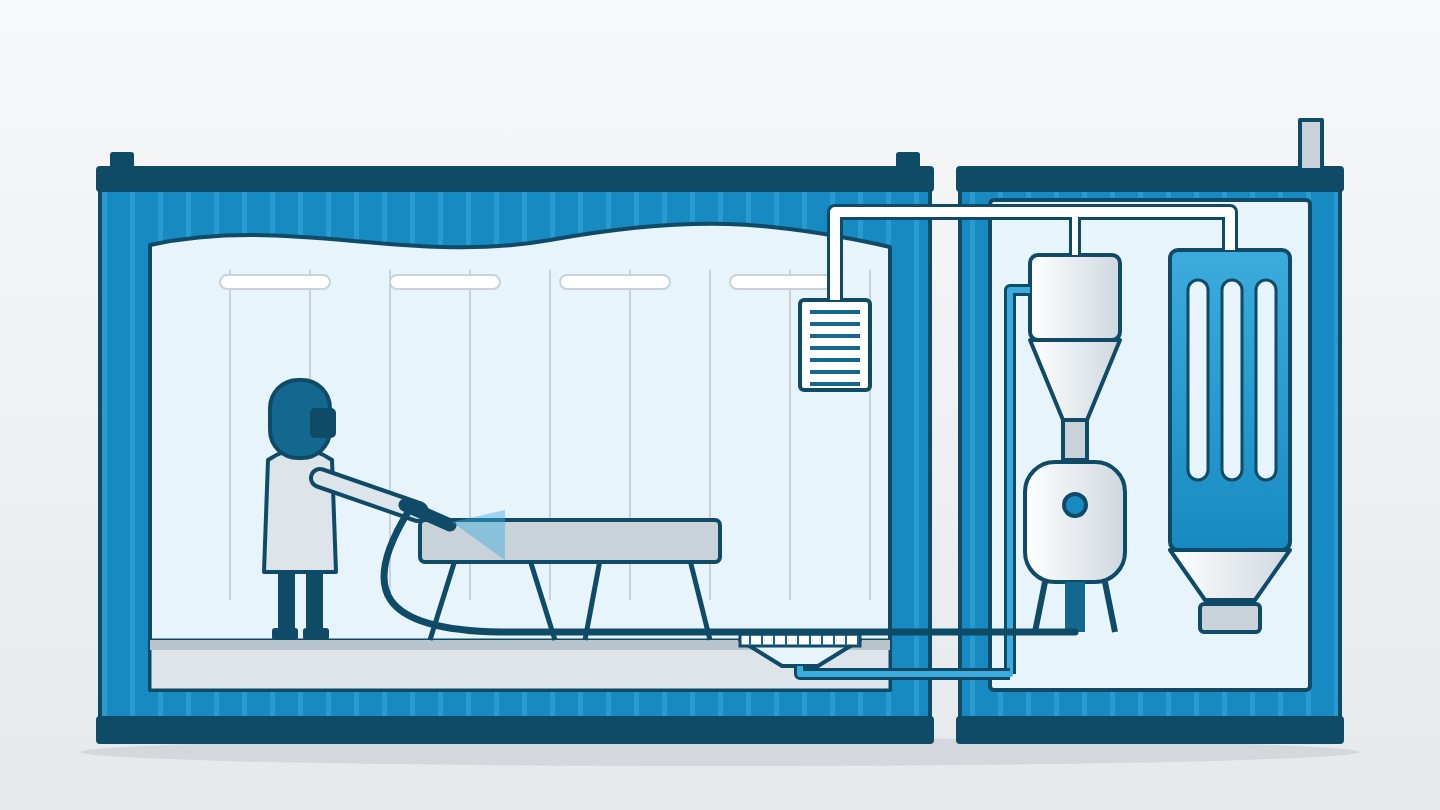
Version and options for HALL-impact Mobile
| Build | Fully assembled in the factory |
|---|---|
| Parts | The complete unit consists of two parts |
| Transport | Can be moved by standard transport |
| Placement | Quick placement; blasting can start right away, without extra construction work |
| Unit | Fitted with a cyclone, a blast pot and a filter with automatic filter cleaning |
|---|---|
| Floor | Flat steel floor |
| Abrasive recovery | Suction hopper, for reuse of the abrasive |
| Wall protection | PVC |
| Lighting and extraction | Present, for good visibility in the space |
| Walls | Sandwich panels, to reduce the noise |
| Extra service door | Possible |
|---|---|
| Drive-on plate | Possible |
| Scraper floor | Possible |
Rather speak to someone first? +32 55 21 98 99
The equipment around it
The abrasive has to reach the operator, come back out of the floor, and the dust has to go. In every blast room three installations do that work.
Consumables
In a room with abrasive recovery the same abrasive keeps circulating until it is worn out. Steel shot and steel grit take mill scale and thick paint layers off structural steelwork.
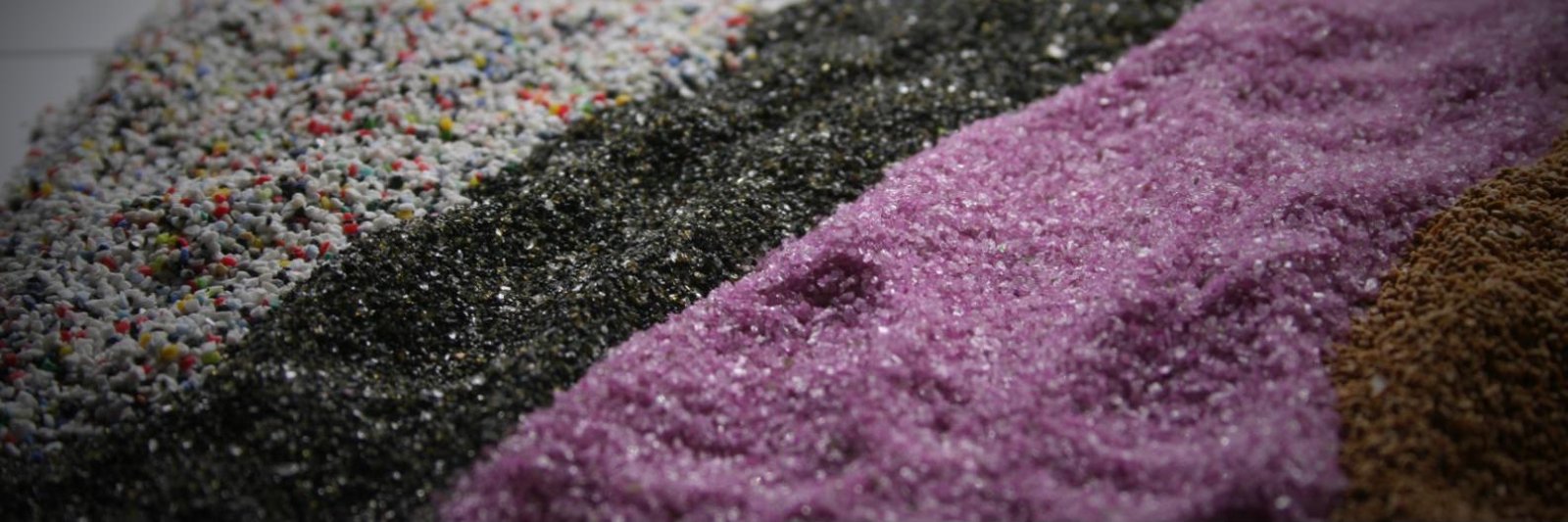
Abrasives, spare parts and protective equipment are supplied by Phibo, so you order them from the partner that installed your equipment.
Service and maintenance
You arrange maintenance, repair and spare parts directly with Phibo. Our own technicians do the work.
We plan the inspection of your installation and follow it up. You agree the content with us.
The spare parts come from our own warehouse. Our technicians carry out the repair.
Your operators learn to run and set the installation, at commissioning.
More on phibo.be
Do your parts fit in a cabinet, or are you looking for the pot that stands in the blasting space? These are the other types.
Send us the dimensions and weight of your largest part, the number of operators blasting at the same time, the free height in your workshop and the compressed air you have available. You get a proposal with the industrial blast room, the walk-in cabin or the blast container that fits. One partner, from the first conversation to the last spare part.
Request
Fill in the form below. With these details we size the blast room, and you get a proposal with the full specifications, down to the connection values.
Do not have those details to hand? Fill in what you know, and we go through the rest with you on the phone.